Most people assume that eating less frequently is either dangerous or unsustainable. Yet a growing number of people practice OMAD, or One Meal a Day, consuming all of their daily calories within a single one-to-two-hour window. Is OMAD just an extreme fasting trend, or does it have legitimate metabolic benefits backed by evidence? A 2007 randomized controlled trial published in the American Journal of Clinical Nutrition found that healthy adults who ate one meal per day maintained their body weight while achieving meaningful reductions in fat mass, without cutting total calories. But the same study also identified cardiovascular trade-offs worth understanding before you start. Here's what the science actually shows.
What Is OMAD and How Does It Work?
OMAD is a form of extreme time-restricted eating (TRE). Where the widely practiced 16:8 protocol compresses eating into an 8-hour window, OMAD narrows this to approximately 1–2 hours, resulting in a daily fast of 22–23 hours. The underlying mechanism is the same as other fasting approaches: by limiting the period during which you consume food, you extend the time your body spends in a fasted metabolic state.
After roughly 12–14 hours without calories, your liver glycogen stores begin to deplete, and your body shifts progressively toward fat oxidation for fuel. Insulin levels fall, which reduces fat storage signaling and promotes lipolysis: the breakdown of stored body fat for energy. OMAD extends this low-insulin, fat-burning state significantly further than standard protocols.
By the time a typical OMAD practitioner reaches their daily meal, more than 22 hours have elapsed since their last food intake. During this window, several metabolic changes occur in sequence:
- Glucose and insulin decline: With no dietary carbohydrate or protein stimulating the pancreas, fasting insulin drops to baseline levels and stays there throughout the day.
- Fat oxidation increases: With glycogen depleted, adipose tissue becomes the primary fuel source, a state associated with fat mass reduction over time.
- Modest ketone production: In prolonged fasting, the liver converts fatty acids into ketone bodies, which provide alternative fuel for the brain and muscles. OMAD is not typically ketogenic, but mild ketosis can occur in the later fasting hours.
- Cellular repair processes activate: Extended fasting periods are associated with upregulation of autophagy: the cellular recycling mechanism linked to longevity, disease prevention, and clearance of damaged cellular components.
What the Research Actually Shows
The most direct clinical evidence for OMAD comes from a 2007 randomized controlled trial by Stote and colleagues, published in the American Journal of Clinical Nutrition. The researchers enrolled 15 healthy, normal-weight middle-aged adults and assigned them to either three meals per day or one meal per day for eight weeks each in a crossover design. Critically, both groups consumed identical total calories, meaning any observed differences were attributable to meal timing alone, not caloric restriction.
The findings were notable in both directions. On the benefit side, subjects eating one meal per day showed significant reductions in fat mass compared to the three-meal condition. Cortisol levels also decreased in the OMAD group, suggesting lower baseline physiological stress responses during the eating pattern. On the risk side, the single-meal group experienced measurable increases in blood pressure and elevations in total, LDL, and HDL cholesterol. The LDL elevation is a cardiovascular risk factor that warrants monitoring, particularly in individuals with existing lipid concerns.
Hunger was a consistent challenge: subjects on OMAD reported significantly higher hunger throughout the fasting period, though they were able to comply with the protocol for the full eight weeks. This practical finding matters: OMAD can be sustained, but it requires tolerance for extended hunger, especially during the adaptation phase.
A broader 2018 systematic review published in the Canadian Family Physician examined 27 intermittent fasting trials involving more than 900 participants. All 27 trials found meaningful weight loss outcomes, ranging from 0.8% to 13.0% of baseline body weight, across IF protocols, with no serious adverse events reported. In five trials that included people with type 2 diabetes, fasting consistently improved glycemic control.
Research by Longo and Anderson, published in Nature Aging in 2022, situates OMAD-style fasting within the broader framework of longevity biology. Their review finds that daily fasting windows of 16–24 hours reliably activate key nutrient-sensing pathways, including AMPK upregulation and mTOR inhibition, that are mechanistically linked to reduced disease risk and extended healthspan across species. The longevity implications in humans remain preliminary, but the cellular mechanisms are consistent and well-characterized.
How to Structure an OMAD Protocol
OMAD's appeal is its simplicity: eat one meal, ideally at the same time each day. In practice, structure makes the difference between a productive protocol and a nutritional shortfall.
Choosing your meal window. Most OMAD practitioners eat in the mid-afternoon or evening. Circadian biology research suggests that eating earlier in the day, around 12:00–2:00 PM, aligns better with metabolic rhythms: insulin sensitivity peaks in the morning and declines toward evening. Earlier eating windows appear to support superior weight management outcomes compared to late-night eating. That said, social and professional realities often make evening windows (5:00–7:00 PM) more practical, and this remains viable for most people.
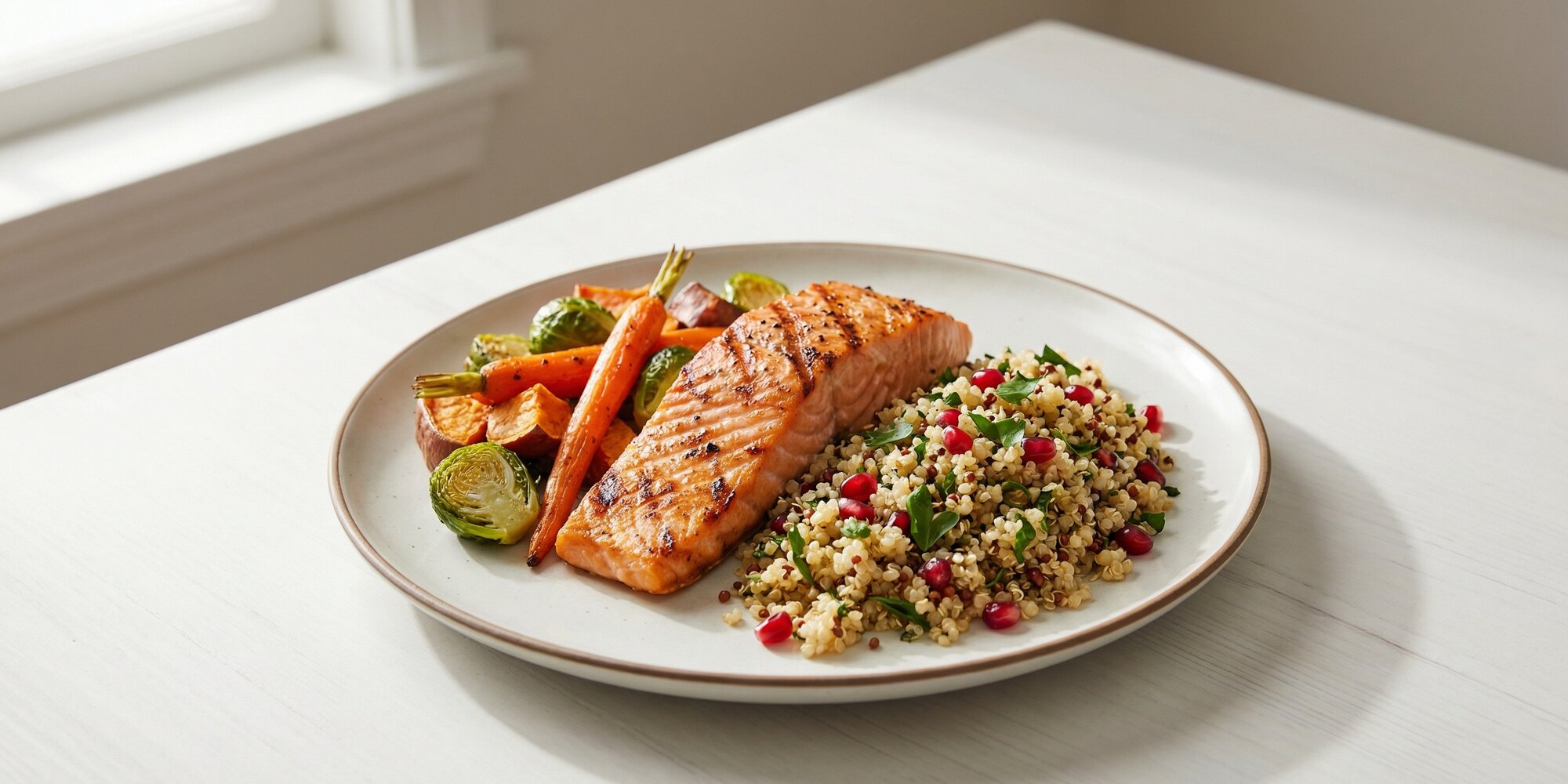
Composing your single meal. Because you are compressing all daily nutrition into one sitting, food quality and completeness matter more than in standard eating patterns. A well-structured OMAD meal should include:
- Substantial protein: Research on muscle protein synthesis recommends 1.6–2.2g of protein per kilogram of body weight per day to preserve lean mass during weight loss. For a 70 kg individual, this means 112–154g of protein at the single meal, achievable but requiring intentional choices (e.g., chicken breast, eggs, legumes, fish, Greek yogurt).
- Fiber-rich carbohydrates: Vegetables, legumes, and intact whole grains support gut microbiome diversity, slow glucose absorption, and extend satiety into the following fasting period.
- Healthy fats: Olive oil, avocado, nuts, and fatty fish provide essential fatty acids, fat-soluble vitamins, and contribute to meal satiety.
- Micronutrient density: A varied, whole-food meal substantially reduces the risk of nutritional gaps. Some practitioners also supplement with magnesium, potassium, and B vitamins, particularly during long-term OMAD practice.
Hydration and electrolytes during the fast. Water, black coffee, and plain tea are generally considered compatible with the fasting window. Electrolyte intake, particularly sodium and potassium, can meaningfully reduce early hunger and common side effects such as headache and fatigue. This is especially relevant during the first one to two weeks of adaptation.
The adaptation period. Most people report a 1–2 week adjustment phase during which hunger is pronounced, energy is variable, and concentration may dip. After this window, hunger signals often normalize as ghrelin, the primary hunger hormone, adapts its circadian rhythm to the new eating schedule. It is worth noting that the scientific evidence for long-term hunger adaptation specific to OMAD remains limited; individual responses vary considerably.
Who Should (and Shouldn't) Try OMAD
OMAD is not a universal protocol. Several populations should approach it with significant caution or avoid it entirely:
- People with a history of disordered eating: Highly restrictive eating patterns can reinforce obsessive food behaviors and exacerbate restrictive eating disorders. This is a firm contraindication.
- Pregnant or breastfeeding individuals: Elevated nutritional demands make extreme caloric compression inappropriate and potentially harmful.
- People with type 1 diabetes or insulin-dependent type 2 diabetes: A 22+ hour fast creates significant glycemic variability that requires close, active medical management. Do not attempt OMAD without direct physician supervision.
- Underweight individuals or those with known nutrient deficiencies: Meeting full caloric and nutritional needs in a single meal is genuinely difficult; the risk of compounding existing deficiencies is real.
- High-volume athletes and those with heavy physical activity demands: Training recovery requires consistent protein distribution throughout the day; single-meal protein absorption may not fully support muscle protein synthesis at high volumes.
- Anyone on medications requiring food: Many medications must be taken with meals or at set intervals; OMAD fundamentally disrupts standard dosing schedules and warrants a conversation with your prescribing physician.
Populations who tend to tolerate OMAD reasonably well include metabolically healthy adults seeking a simplified eating structure, those who have already successfully practiced 16:8 or 18:6 for several months, and individuals who find traditional calorie-counting unsustainable and prefer a clear timing-based rule.
Risks, Trade-Offs, and Realistic Expectations
The Stote et al. trial's finding of elevated LDL cholesterol, even with identical caloric intake to three meals, deserves to be taken seriously rather than dismissed. While HDL cholesterol also increased (a positive signal in cardiovascular risk modeling), total LDL elevation represents a meaningful risk factor that should be monitored, particularly in individuals with pre-existing lipid abnormalities or family history of cardiovascular disease. Blood pressure elevation in the same study adds a further layer of caution.
It is also important to recognize the limitations of the available evidence. The primary OMAD trial involved 15 participants over 8 weeks. There are no large, long-term randomized controlled trials specifically examining OMAD in diverse human populations. The current data is promising but insufficient to make strong claims about multi-year health outcomes, cardiovascular risk, or all-cause mortality.
Practical risks are also worth acknowledging:
- Compensatory overeating: Some people find that the intensity of hunger after a 22-hour fast leads them to consume significantly more calories than they would have across three meals, effectively eliminating the caloric deficit they expected.
- Nutritional gaps: Meeting all micronutrient targets in a single meal requires consistent planning. Casual OMAD without attention to food quality frequently results in inadequate intake of calcium, iron, zinc, and several B vitamins.
- Social friction: Eating is a social activity woven into work lunches, family dinners, and cultural events. Restricting all food intake to a single narrow window creates real-world complications that affect adherence and quality of life for many people.
The key takeaway from the current evidence: OMAD can achieve meaningful body composition changes, specifically fat loss without caloric restriction, but it is not without genuine trade-offs. If you are considering OMAD, starting with less aggressive time-restricted eating protocols (16:8, then 18:6) allows you to assess your body's response before compressing to a single daily meal. When you do start, prioritize the nutritional completeness of that meal above everything else, because the simplicity OMAD offers on the timing side demands corresponding effort on the composition side.
Sources
- Stote KS et al. A controlled trial of reduced meal frequency without caloric restriction in healthy, normal-weight, middle-aged adults. Am J Clin Nutr. 2007;85(4):981-8.
- Harris L et al. Intermittent fasting and weight loss: Systematic review. Can Fam Physician. 2020;66(2):117–125.
- Longo VD, Anderson RM. Intermittent and periodic fasting, longevity and disease. Nature Aging. 2022;2(1):3–17.